 +91-8800903073, 8452810712

Ultrananaotech
NANO PARTICLES IN NEXT-GEN BATTERIES
25
Nov
Introduction
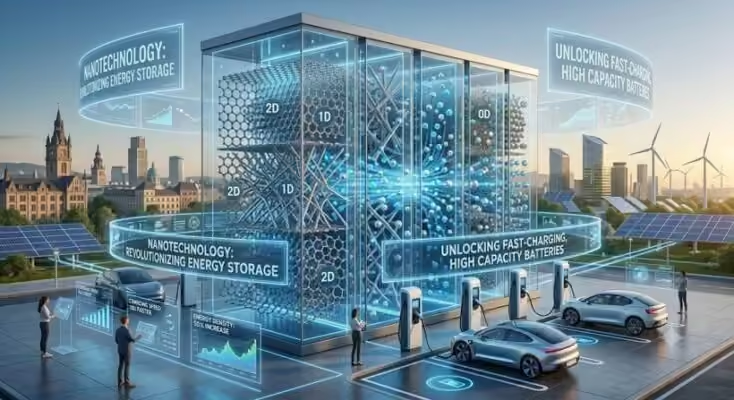
We are living in an era of rapid technological breakthroughs—from electric vehicles transforming our lives to smartphones that act as pocket-sized supercomputers. Yet, behind all of this progress lies a shared, invisible challenge: our need for better, faster-charging, and longer-lasting batteries. The world is moving fast, but our ability to power that world is struggling to keep up.
To solve this massive energy bottleneck, scientists have stopped looking for bigger solutions. Instead, they have turned their attention to the smallest spaces imaginable: the nanoscale.
This shift requires us to rethink how we look at matter entirely. In our everyday lives, we are used to bulk materials—the large-scale substances used in traditional battery electrodes. But when you shrink those exact same materials down to nanoparticles, the ordinary rules of physics change. At this microscopic frontier, materials unlock massive surface area, hyper-fast ion transfer, and storage properties that simply do not exist at the macro scale.
What is a battery ?
Before we can look at how nanotechnology is rewriting the rules of energy storage, we have to understand the basic playground we are working in. At its core, a battery doesn’t actually “store” electricity; it stores chemical energy and converts it into electrical energy on demand. To do this, every battery relies on three main components:
- The Anode (The Giver
- The Cathode (The Receiver
- The Electrolyte & Separator (The Highway & Gate)
TYPES OF BATTERY
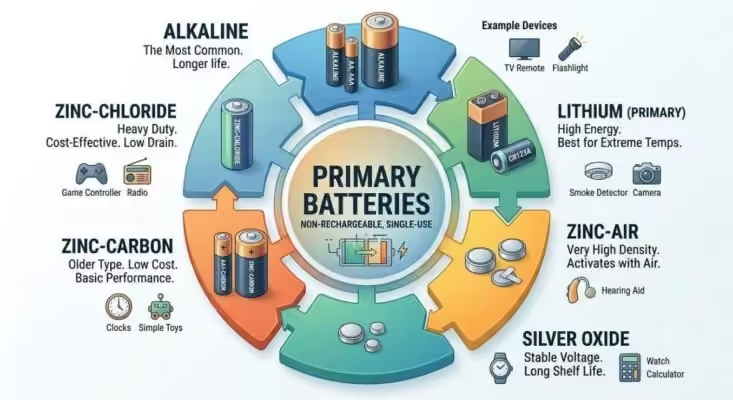
Primary (Disposable) Batteries: These are designed for one-time use. Once the internal chemical energy is exhausted, the reaction cannot be reversed, and the battery must be thrown away. They are best suited for low-power devices where long shelf life and convenience are the priority.
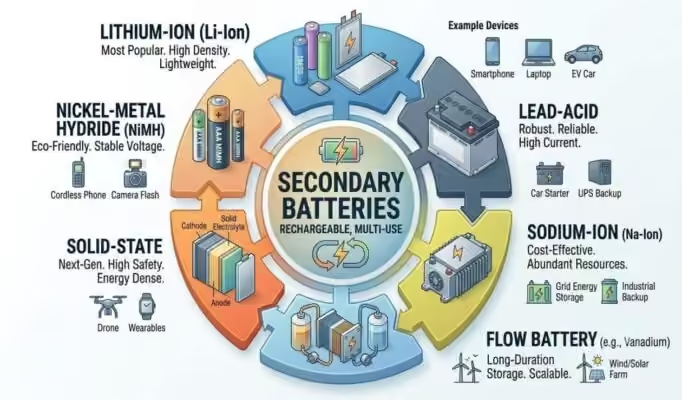
Secondary (Rechargeable) Batteries: These use reversible chemical processes, allowing you to restore their capacity by applying an external electrical current. This enables them to be discharged and recharged repeatedly over time.
Current Bulk Battery Li-ion battery :
A lithium-ion (Li-ion) battery is a type of rechargeable battery that powers most of the modern portable devices we use daily, from Smart phones and laptops to electric vehicles (EVs). Unlike disposable batteries, lithium-ion batteries are “secondary” batteries, meaning they can be charged and discharged hundreds or even thousands of times. Despite this it is facing some physical and chemical limitations .
Limitations of current Li -ion battery:
- Energy density ceiling : current Li- ion has energy density ceiling around 250 -300 wh/kg . because conventional graphite anode can hold only a fixed amount of L/I-ion . so , if we want a Li-ion battery to store more energy it usually means making it bigger and heavier.
- Slow charging time : while charging the extrenal pressure forces the Li-ion to move from cathode to anode . forcing them to move too quickly through fast charging generates intense heat and causes spike-like structures called dendrites which severely degrades battery health over time and increases risk of short circuit.
- Thermal and fire safety: current Li-ion battery use flammable organic liquid electrolytes. Any physical damage ,manufacturing defects or over heating can cause thermal runway.
- Material Degradation & Aging:Every time a battery charges and discharges, its bulk materials expand and contract. Over hundreds of cycles, this mechanical stress causes micro-cracks in the electrodes.thus Batteries lose capacity over time, usually lasting only 3 to 8 years before needing replacement.
- Raw Material & Environmental Bottlenecks:Conventional batteries rely heavily on critical, scarce minerals like cobalt, nickel, and refined lithium.Extracting these minerals consumes massive amounts of water and damages ecosystems, while tight supply chains keep production costs high
Introduction To Nanoparticles:
Nanoparticles are ultra small particles of matter that measures between 1 and 100 nm where 1nm =10√9 m
Because they are so small, they don’t look or act like a powder or a fluid you’d see in daily life. Instead, they come in unique shapes and dimensions engineered in a lab
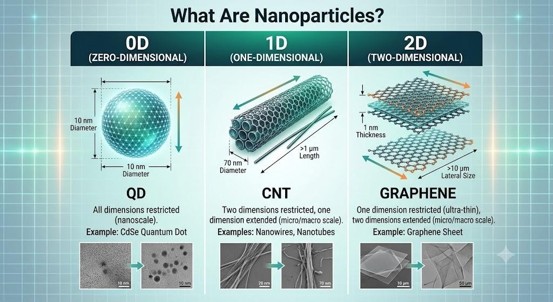
Role of nanoparticles in upgrading batteries:
By switching from bulk matter to nanostructures, scientists are fixing the core physical limitations of current technology
- Massive Surface Area: Breaking bulk matter into nanoparticles creates an extraordinarily large electrochemically active surface area. This provides millions of active reaction sites for lithium ions to enter and exit simultaneously.
- Ultra-Short Ion Pathways: Nanomaterials shrink the physical travel distance for ions from micrometers down to mere nanometers. Shorter pathways enable rapid ion diffusion, lowering internal resistance and unlocking hyper-fast charging.
- Unlocked Storage Capacity: Nanostructures accommodate high-capacity materials (like silicon) that would normally crack under expansion. This structural resilience allows batteries to hold significantly more energy per charge without degrading
While these core upgrades are impressive, the real magic happens when scientists combine two distinct nanomaterials to create something revolutionary.
The Silicon-Graphene Nanocomposite:
A Silicon- Graphene battery is a regular lithium-ion battery that has received a major upgrade at its negative terminal (the anode). Instead of using standard, bulky graphite to store the lithium ions, scientists have created a microscopic composite material made of Silicon Nanoparticles and Graphene Sheets.
To understand why this is a genius move, we have to look at the two characters:
Ø The Silicon Nanoparticle (The Muscle) :
The Superpower: Silicon is an absolute storage beast. While traditional graphite can only hold a small amount of lithium, silicon can bond with up to 4.4 lithium atoms per silicon atom. This gives silicon a theoretical energy storage capacity nearly of 10 times higher than graphite . When silicon absorbs all that lithium during charging, it swells up like an overinflated balloon, expanding by 300% to 400%. Within just a few charge cycles, the silicon literally explodes and crumbles into dust, ruining the battery
Ø The Graphene Sheet (The Shield & Super-Highway) :
The Superpower: Graphene is a single-atom-thick sheet of carbon. It is the strongest material ever tested, incredibly flexible, and is one of the best conductors of electricity on Earth. Graphene doesn’t store the lithium itself; instead, it acts as a protective, elastic cage around the silicon nanoparticles. Scientists leave a tiny microscopic gap called Buffer space between the silicon and the graphene shell.
- During Charging: Lithium ions flood into the The silicon “yolk” swells up to 4x its size. Because of the buffer space and the super-strong, elastic graphene shell, the silicon expands safely without cracking the outer structure.
- During Discharging: The lithium leaves, and the silicon safely shrinks back down to its original
The graphene cage remains completely intact, preserving the electrical connection.
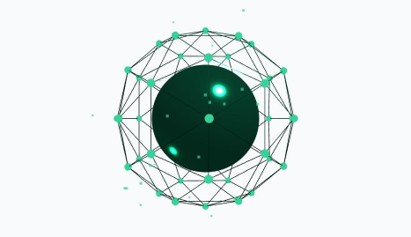
Silicon nano caged inside graphene sheet
What Real-World Problems Does This Battery Actually Solve?
- Maximum Energy Density & Skyrocketing Range: Silicon-graphene isn’t a totally new battery chemistry—it’s an ultra-optimized version of standard lithium-ion that pushes physical limits. Because standard graphite anodes are maxed out, traditional EVs must add heavy battery cells to gain range, diminishing returns. Silicon can store up to 10 times more lithium than graphite. Swapping to silicon-graphene delivers over 500 miles (800+ km) of range in the exact same physical space without adding weight, effortlessly handling long road trips.
- Rapid Charging Without Degradation: Slow charging is a major pain point, but forcing high currents into standard graphite causes overheating and severe Graphene’s exceptional conductivity solves this by acting like a fast-flowing highway, allowing lithium ions to move rapidly into the anode without damaging heat build-up. This reduces charging times to just 10–15 minutes, making a top-up as fast as a typical coffee break.
- Slimmer Devices or Longer Smartphone Battery Life: Modern smartphones are constrained by internal space, preventing brands from adding larger batteries alongside power-hungry AI chips and bright Nano-silicon allows battery size to shrink by 15–20% while maintaining identical capacity. Manufacturers can use this saved space to fit better cameras and cooling components, or keep the original phone size to provide multi-day battery life.
THE ULTIMATE QUESTION IN TECH IS : IF THIS SCIENCE IS SO FLAWLESS, WHY ISN’T IT ALREADY POWERING MY PHONE AND MY CAR?
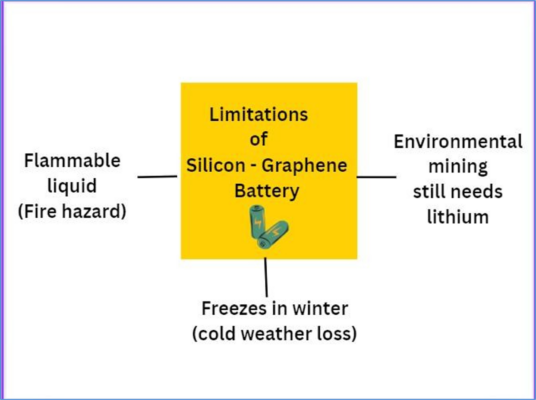
LIMITATIONS OF SILICON – GRAPHEME BATTERY :
- It could not solve some of the major issues like minning , fire hazard and freezing of electrolyte during winter
- While silicon is cheap , high grade grapheme is difficult and expensive to produce

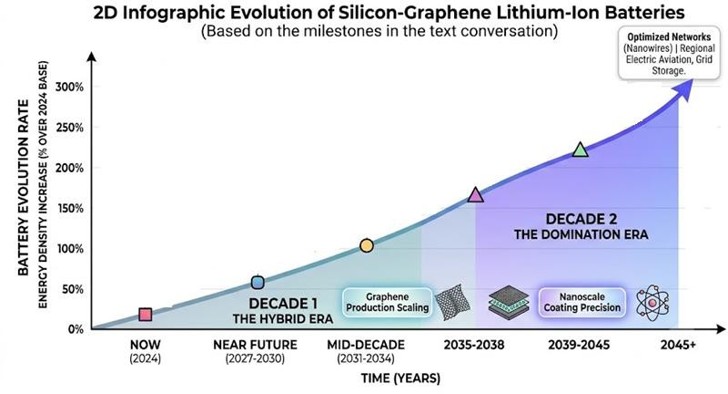
The Current Timeline: When Will You Actually Buy One?
CONCLUSION: The Tiny Particles Powering Tomorrow
For the last century, human innovation was largely defined by making things bigger—building larger factories, massive combustion engines, and sprawling power grids. But the future of clean energy hinges entirely on our ability to engineer things smaller.
By mastering the nanoscale universe—wrapping temperamental silicon atoms inside flexible graphene cages—we aren’t just building a slightly better phone battery. We are laying the invisible foundation for a fully electrified, fast-charging world. The energy revolution isn’t waiting on a distant, mythical invention; it is already happening right now, quietly scaling up one atom at a time.
Courtesy: Shatabdi, Intern at Ultrananotech Pvt Ltd
