 +91-8800903073, 8452810712
Ultrananaotech, ULTRANANOTECH
NANOBOTS: Role of Artificial intelligence (AI) in enhancing the efficiency of nanobots.
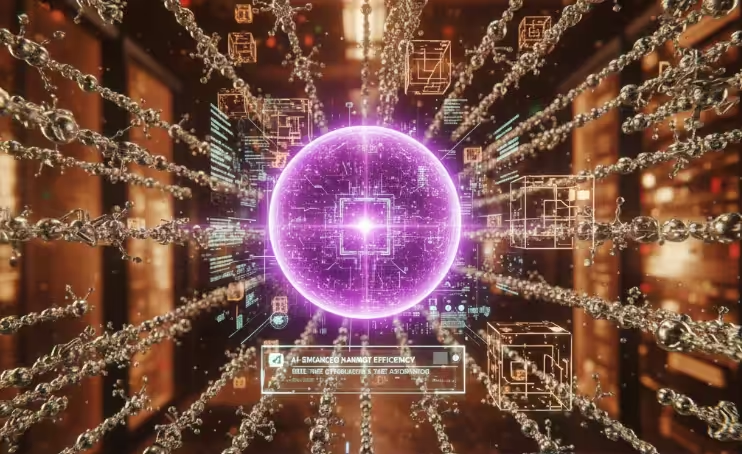
18
Sep
Sep
INTRODUCTION:
Nanotechnology is the science of working with materials at the tiny nanoscale about one billionth of a meter. In today’s world, Artificial intelligence (AI) is helping to make many things faster and more efficient than humans can. Nanorobotics, refers to the creation and application of robots or machines with components at the nanometer scale. So, what if AI is combined with Nanobots?
The combination of AI and Nanobots could lead to amazing and powerful inventions or solutions that change science, technology, or even our daily lives.
But how exactly does AI speed up the development of Nanobots?
What is nanobot?
Nanobots are also called nanorobots. These are microscopic robots are engineered at nanoscale or atomic level (approximately 1 to 100 nanometers). These are extremely small and typically 50-100 nm in width. These are designed to perform specific functions. Their small size is an advantage and allows for precise targeting and manipulation at the nanoscale, enabling advancements in drug delivery, diagnostics, surgical procedures and other applications where atomic label manipulation is required.
How can it be helpful for various purposes?
Nanobots are widely used in the niche technology domain like Medicine, Environmental Science, Electronics, Military and Defense, Agriculture, etc.
MEDICAL SCIENCE:
Targeted drug delivery: Nanobots can deliver drugs directly to the specific cells like cancer cells, without affecting any healthy cells. Nanobots can be programmed to deliver drugs directly to specific cells or tissues, and minimizing harm to healthy cells by reducing side effects associated with traditional therapies. They can also be used to deliver drugs to a specific site which is otherwise difficult to reach, areas of the body, like the brain or inside a tumor. Nanorobots can be navigate through the body’s vascular system and interact with cells and tissues in ways that are impossible with traditional surgery.
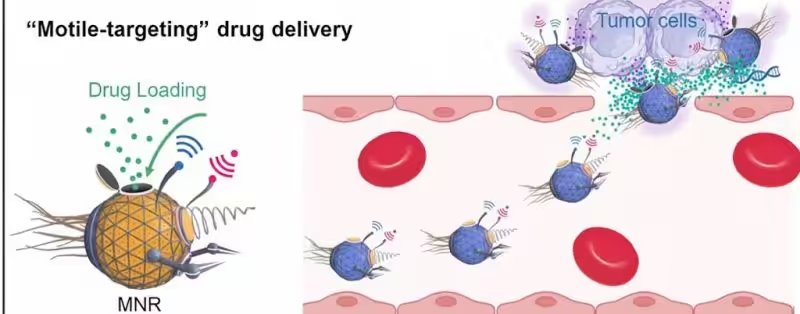
Figure 1: Targeting drug delivery inside a tumor cell by MNR.
Minimally Invasive Surgery: Nanobots can be used to perform complex surgical tasks at the cellular level, potentially eliminating the need for traditional, invasive surgeries. They could be used to clear blocked arteries, repair damaged tissue, and perform complex procedures within the eye or brain. In minimally invasive surgery, nanobots can be used to perform intricate procedures with greater precision and less tissue damage than traditional methods. In case of DNA repair, they can be designed to identify and correct genetic abnormalities, potentially revolutionizing the treatment of genetic disease
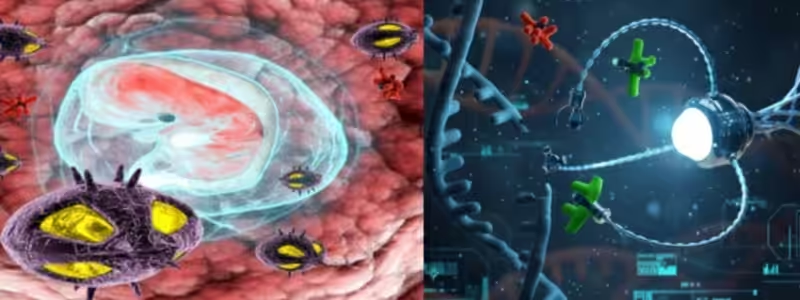
Figure 2: Nanobots perform complex surgical tasks and repairing damaged tissue.
Early Disease Diagnosis: Nanobots, or nanorobots, hold significant promise for revolutionizing disease detection. Their small size allows them to navigate through the body and detect diseases at the molecular level with greater sensitivity and speed than conventional methods. Nanobots can be engineered to identify specific biomarkers indicating the presence of cancer, infectious diseases, or other conditions, enabling early diagnosis and timely interventions. Recent studies have shown that nanobots have powerful capabilities in purification, detoxification, and sensing. Their controllable driving characteristics allow nanobots to actively search for target objects to be cleared, greatly improving detection and removal efficiency.
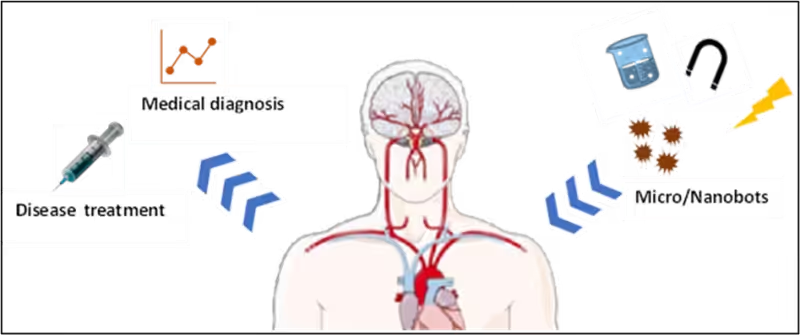
Figure3: Early diagnosis of diseases with the help of nanobots.
ELECTRONICS
Circuit repairing: The process of finding and fixing problems in electronic circuits is called circuit repairing. These circuits are found in devices like TVs, Phones, laptops, etc. Nanobots can enter microscopic parts of circuits that are too small for humans to reach. They detect tiny cracks, corrosion, or faults in circuit lines or chips.
Nano-Assembly: Nanobots can be used to manipulate atoms and molecules to build nanoscale components like transistors, capacitors, and logic gates, etc. It is essential for producing quantum dots, nano-transistors, and molecular circuits. The success of nano scale circuits and their performance depends on the engineering or manipulation of the circuit at the atomic scale. Nanorobot can play a crucial role in circuit or device assembling.
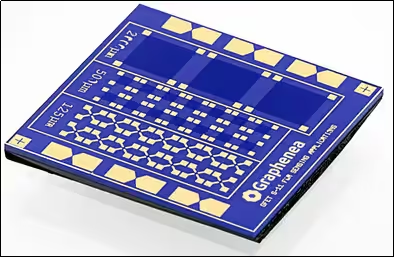
Figure 4: GFET-S11 for Sensing applications.
ENVIRONMENTAL APPLICATIONS:
Water purification: Less than 1% of Earth’s freshwater reserves is accessible. Rapid industrialization, urbanization and population growth lead to climate change. This adverse effect of climate change results in a shortage of clean and drinkable water. Nanobots are revolutionizing water purification by targeting contaminants at the molecular level. Nanobots can detect with nano-sensors, neutralize by binding to heavy metal ions, and remove them. It also breaks down organic toxins using catalytic reactions.
Oil spill cleanup: The process of removing or minimizing the environmental impact of oil released into oceans, rivers, or coastal areas due to accidents like tanker spills, pipeline leaks, etc. Oil spills frequently cause devastating impacts on coastal ecosystems and communities. Nanobots are microscopic devices, often made from nanoparticles and designed to detect or remove oil from contaminated water. Nanotechnology is proving to be a valuable tool in cleaning up these oil spills or leaks in the water by utilizing magnetic nanomaterials such as functionalized super-paramagnetic iron oxide nanoparticles (SPIONs), magnetic nanocomposites and magnetic carbon nanotubes (CNTs).
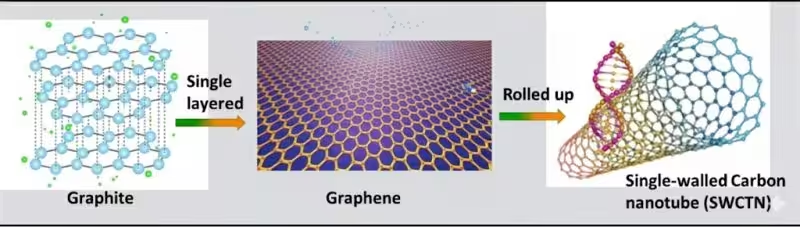
Figure 5: Carbon nanotube (CNT) made from graphene.
MILITARY AND DEFENCE:
Nano weapons: There are different types of nano weapons like nano drones; there are some drones that are very small, unmanned aerial vehicles (UAVs) designed for versatility and precision applications. Nano enhanced traditional weapons that make them lighter, stronger, and heat resistant. Some tiny nano sensors can detect the movement and leaked radiation that can be useful in enemy tracking. Nano sensors have various applications in defence and military, including detecting chemical and biological agents.
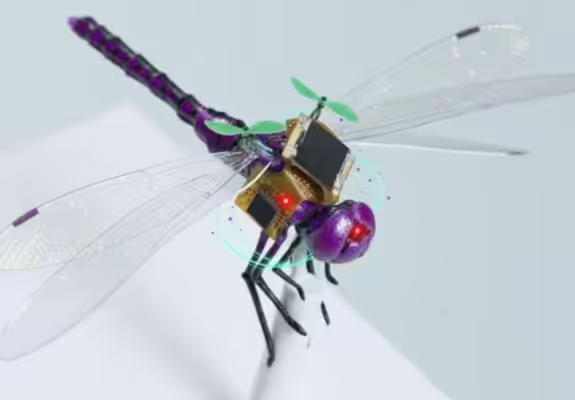
Figure 6: Nanotech weapon system and advanced Nano drone.
Soldiers Health Monitoring: Nano sensors track fatigue, hydration, injuries and stress levels of soldiers at all times in the battlefield. Nano-drugs which are made up of different nanoparticles which are used for quick treatment of wounds or infections on the battleground. Nano-biosensors can also detect blood infections and harmful bacteria.
AGRICULTURAL APPLICATIONS:
Pest and disease detection: Nanobots can be used to detect early signs of plant diseases at a microscopic level and some devices are being developed to kill pathogens or pests directly from their root source.
Soil and plant sensing: Nano biosensors help to detect biotic or abiotic stresses, nutrient levels, soil moisture, temperature etc. They contribute to improved plant productivity, reduced resource wastage and promote ecofriendly farming.
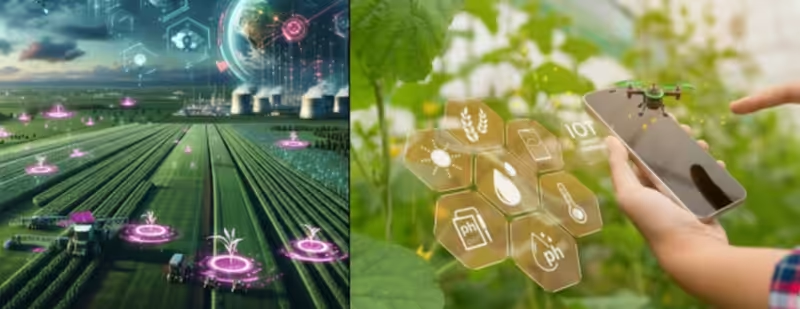
Figure7: A systematics diagram of sustainable farm practices and nano biosensor.
FUTURE OF NANOBOTS WITH AI:
The convergence of Nanotechnology and Artificial Intelligence in the field of manufacturing has experienced a revolution in recent years. Nanotechnology has empowered us to manipulate materials at the nanoscale, displaying new and unique functionalities, while artificial intelligence is being used to design and optimize these materials with novel advancements in efficiency, speed, and accuracy. The chapter aims to summarize the development of nanotechnology and AI in various trending fields, including 3D printing, cooking, renewable energy, autonomous vehicles, etc. This chapter systematically explores the combined workings of two technologies, from creating more innovative materials to developing new manufacturing methods using biotechnology, architecture and hardware design, robotics, hybrid techniques, and problem-solving skills. Eventually, the brief overview represents a future perspective on these two technologies, which are dignified to change the world.
CHALLENGES:
- Developing AI algorithms that can devotedly function in unpredictable biological environments, such as the presence of proteins, antibodies, or varying pH levels, is a significant challenge.
- Ensuring the safety of nanobots and preventing harmful use, such as hacking or unauthorized control, is crucial.
- The development and training of AI models for nanobot applications often require large and high-quality datasets that may be difficult to acquire.
CONCLUSION:
Artificial Intelligence (AI) technology has been developing for many years now, not only as an area of technology but also in the various spaces and industries where it can now be found. Developing and improving efficient algorithms and software to address the remaining unanswered issues is crucial due to the exponential growth in computational costs as these systems become larger and more advanced.
References
- Sarah Moore, (Dec 20 2019). how are carbon nanotubes made from graphene?
- Chinmay Kulkarni, (Aug 10, 2021). Nanotechnology in electronics. introduction and various applications of nanotechnology in the field of electronics.
- Zhang Y., Zhang Y., Han Y., Gong X., (2022).Micro/nanorobots for medical diagnosis and disease treatment. Micromachines 13(5), 648. https://doi.org/10.3390/mi13050648050648.
- Zhang D., Liu S., Guan J., Mou F., (16 September 2022). Front. Bioeng. Biotechnol., Sec. Nanobiotechnology. Volume 10, https://doi.org/10.3389/fbioe.2022.1002171.
- Afshin Rashid, (August 27, 2024). The Term “Nano-Transistor” Comes from The Combination of “Nano-scale” in Transmission and Resistance. DOI: 10.22541/au.172479168.84284556/v1
Courtesy:
Md. Nasim Uddin
Intern- Ultrananotech Pvt. Ltd. Bengaluru
