 +91-8800903073, 8452810712
Ultrananaotech, ULTRANANOTECH
Cracking Crimes with Nanotech: The Role of Nanopowders in Forensic Investigations

19
Aug
Aug
Forensic science is the art and science of solving crimes by analyzing physical evidence. In recent years, use of nanopowders—has revolutionized how investigators detect and analyze evidence. But what exactly are nanopowders, and how do they help to catch criminals?
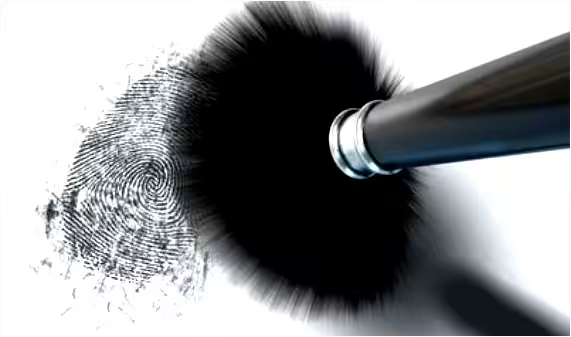
What Are Nanopowders?
Nanopowders are extremely fine particles with sizes less than100 nanometers (a nanometer is one-billionth of a meter).To put this in real world perspective, these particles are thousands of times smaller than the width of a human hair and even smaller than the wavelength of visible light, which makes them invisible to the naked eye.
Because of their tiny size, nanopowders have unique physical and chemical properties that differ greatly from bulk counter parts the same material.
Nanopowders possess unique traits that set them apart from bulk materials, those are listed below-
- Nanopowders have an enormous surface area compared to their volume, making them highly reactive.
- These materials can exhibit special optical, electrical, and magnetic behaviors.
- These nanoparticles can interact with molecules at a very precise level.
Nanopowders can be synthesized from chemical compounds containing metals like gold or silver, or from metal oxides such as titanium dioxide and zinc oxide.
Nanopowders or nanoparticles are primarily synthesized using two main strategies — the top-down and bottom-up approaches.
- In the top-down method, bulk materials are broken down into nanoscale particles through processes like milling, lithography, or laser ablation.
- The bottom-up approach, on the other hand, builds nanoparticles atom-by-atom or molecule-by-molecule through techniques such as chemical precipitation, sol–gel synthesis, or vapor deposition.
Each method offers control over particle size, shape, and properties, making them suitable for different applications.
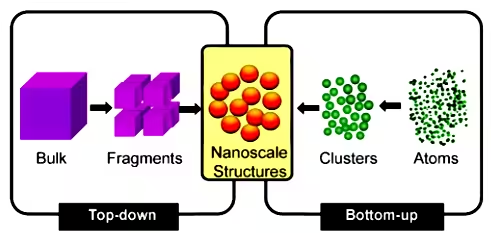
Figure 01: “Top-down” and “bottom-up” synthesis of nanofabrication.
(Source: https://www.researchgate.net/figure/Top-down-and-bottom-up-synthesis-of-nanofabrication_fig1_277574475)
How Are Nanopowders Used in Forensic Science?
Nanopowders have become powerful tools in forensic investigations. Their unique properties allow forensic scientists to detect, visualize, and analyze evidence that traditional methods might miss.
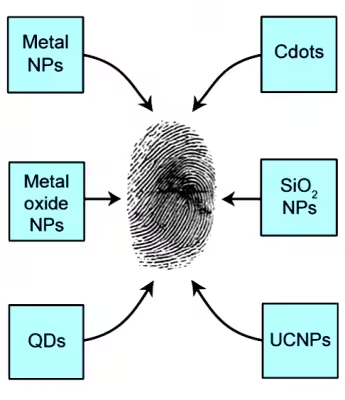
Figure 02: Different nanoparticles for the nanopowders preparation
(Source-https://doi.org/10.1002/wfs2.1341)
1.Latent Finger print Detection
Latent fingerprints are the invisible prints left behind from sweat, oils, or other residues on a surface. The finer size of nanoparticles plays a vital role in fingerprint detection, as they can adhere more effectively to the minute details of ridge patterns. Traditional powders often fail on complex, dark, or textured surfaces.
Nanopowders, however, offer significant advantages in such Forensic scenarios, including:
- Smaller and can settle into tiny ridges of finger prints.
- More visible under ultraviolet (UV) or alternate light sources.
- Less damaging to the surface or the finger print pattern.
Commonly used nanopowders for the fingerprint detection: Titanium dioxide (TiO₂) – for white surfaces, Zinc oxide Quatum dots–for luminescent finger print detection, Carbon-based nanopowders– for dark backgrounds.
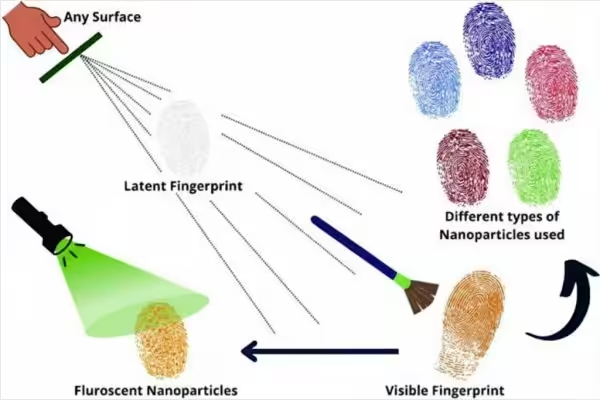
Figure 03: Role of nanoparticles in the latent finger print detection
(Source-https://media.springernature.com/lw685/springer-static/image/chp%3A10.1007%2F978-981-99-4028-8_1/MediaObjects/524413_1_En_1_Fig1_HTML.png)
2. Gunshot Residue (GSR) Analysis
Gunshot residue (GSR) is a mixture of microscopic particles from the bullet, primer, and propellant that may settle on a shooter’s hands, clothing, or nearby surfaces after a firearm is discharged. In forensic science, nanoparticles are increasingly used in GSR analysis because their ultra-fine size and high reactivity allow them to efficiently capture and detect these tiny particles.
Key advantages of nanopowders in GSR detection include:
- Trapping and identifying GSR particles quickly and accurately.
- Working with SEM (Scanning Electron Microscopy) and EDX (Energy Dispersive X-ray Spectroscopy) to analyze particle shape and composition.
- Using specific nanopowders — Lead (Pb), Bismuth (Bi), and Antimony (Sb) to mimic and detect residues, and magnetic iron oxide (Fe₃O₄) to separate and concentrate GSR from samples.
Common nanopowders used for the GSR analysis:Lead(Pb), Bismuth(Bi),and Antimony(Sb) nanopowders – mimic and detect residues, Magnetic iron oxide (Fe₃O₄) nanopowders – help separate and concentrate GSR from samples.
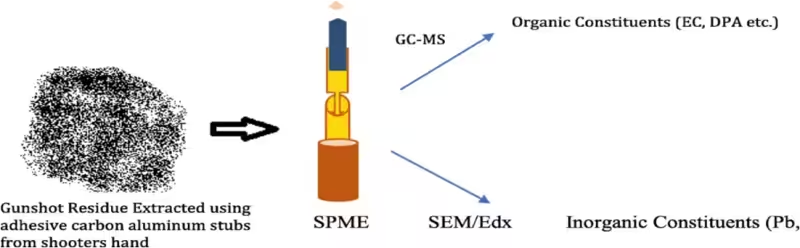
Figure 04: Gunshot residue analysis technique using solid-phase micro extraction. SPME, Solid-phase microextraction; EC, ethyl centralite; DPA, diphenyl amine
(Source – https://ejfs.springeropen.com/articles/10.1186/s41935-021-00223-9/figures/4)
3. Explosive Detection
Nanopowders are employed in the detection of trace amounts of explosive materials such as TNT (Trinitrotoluene), RDX (Research Department Explosive or Cyclotrimethylenetrinitramine), and ammonium nitrate. Due to their extremely fine particle size and large surface area, these powders can be chemically modified to react selectively with explosive molecules, enabling high sensitivity and rapid detection. Their optical, magnetic, or color-changing properties can also be tailored to produce visible or instrument-detectable signals, making them valuable in field screening and forensic analysis.
Technique: Surface Enhanced Raman Spectroscopy (SERS) using gold or silver nanopowders boosts the signal of target molecules,making even tiny traces detectable.
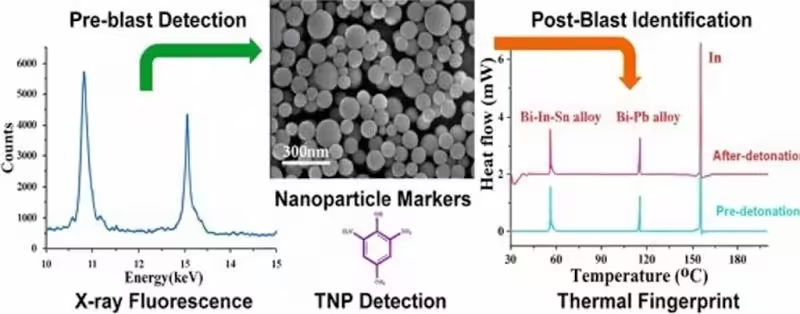
Figure 05: An example Graphical data of finding the explosives using nanopowders
(Source-https://ars.els-cdn.com/content/image/1-s2.0-S0927775720306208-ga1.jpg)
4.DNA Extraction and Purification
Obtaining clean DNA from mixed or degraded biological samples is often challenging in forensic and biomedical investigations. Magnetic nanopowders offer a powerful solution by combining high selectivity with ease of use. They enable scientists to work more efficiently, even with limited or compromised samples, through the following advantages:
- Selectively bind to DNA strands.
- Allow quick and efficient separation using magnets.
- Reduce contamination and improve yield.
Just as hemoglobin levels in our blood depend on sufficient iron intake, the availability and concentration of DNA in a sample can greatly influence the success of extraction. When DNA is more abundant and concentrated, it is more easily attracted to magnetic nanoparticles. This strong binding facilitates cleaner separation and higher recovery rates, making magnetic nanopowders an invaluable tool for extracting DNA from various biological sources across the body.
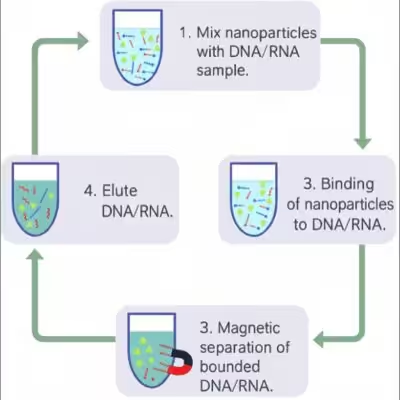
Figure 06: DNA/RNA Purification using magnetic nanopowders
(Source – https://nvigen.com/wp-content/uploads/2018/11/magvigen-dna-rna-purification-workflow.gif)
Commonly used nanopowders for DNA extraction :Silica-coated magnetic iron oxide nanoparticles.
5.Poison and Heavy Metal Detection
Poisonous and heavy metal detection is a critical aspect of forensic science, helping to identify harmful substances that can cause severe health damage or death. Nanopowders have proven highly effective in this area due to their large surface area, high sensitivity, and ability to be chemically tailored for specific targets. These properties enable the detection of even trace amounts of hazardous elements in complex biological or environmental samples.
In forensic applications, they are used for:
- Detecting heavy metals such as mercury, lead, cadmium and also toxic substances like arsenic.
- Monitoring poisoning through blood, urine, or tissue samples.
- Enabling rapid on-site screening with portable detection devices.
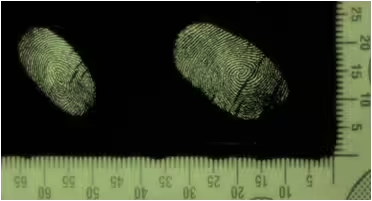
Figure 07: Fluorescent nanopowders for fingerprint detection (Source – https://www.sciencedirect.com/science/article/abs/pii/S1355030623000461)
Why Are Nanopowders a Game-Changer in Forensic Science?
- Ultra-Sensitive Detection: Nanopowders can detect evidence at molecular or even atomic levels, revealing clues invisible to conventional methods.
- Non-Destructive: Many nanoparticle-based techniques preserve the evidence, allowing further testing.
- Versatility: They work on a wide range of evidence types—fingerprints, biological fluids, drugs, explosives, and more.
- Speed and On-Site Testing: Nanoparticle sensors enable rapid screening directly at crime scenes.
- Long-Term Stability: Nanopowders help preserve evidence like fingerprints for extended periods without loss of quality.
Challenges and Future Directions
While nanopowders offer incredible benefits, there are challenges such as:
- Standardization of Nanoparticle Production: One major challenge is achieving uniform size, shape, and quality of nanopowders. Standardized synthesis protocols are essential to ensure reproducible and reliable forensic results across different laboratories.
-
Safety and Toxicity Concerns: Nanoparticles can pose unknown health risks due to their high reactivity and small size. Future directions must focus on developing safer formulations, proper handling protocols, and regulatory guidelines to protect forensic personnel.
-
Training and Skill Development: Forensic experts require specialized training to effectively use nanopowder-based tools. Integrating nanotechnology education into forensic curricula and continuous professional workshops will be crucial for wider adoption.
Ongoing research aims to develop multifunctional nanopowders that combine detection,imaging,andpreservationcapabilities,furthertransformingforensic science into a high-tech, precise discipline.
Conclusion
Nanopowders may be invisible to the eye, but their impact on forensic science is enormous. By enabling ultra-sensitive detection and clearer visualization of evidence, these tiny particles are helping forensic experts solve crimes more efficiently and accurately than ever before. As nanotechnology continues to advance, the future of forensic investigations looks brighter—and smaller—than ever.
References
- Sharma,B.,etal.(2015).Advances in Nanotechnology for Detection and Forensic Applications. Nanomedicine, 10(14), 2221–2232. [DOI:10.1016/j.nano.2015.06.013]
- Singhal,R.,etal.(2012).Luminescent Nanomaterials for Fingerprint Detection: A New Approach. Current Science, 102(7), 983–990.
- Brożek-Mucha, Z. (2011). Scanning Electron Microscopy in GSR Analysis withNanopowderAdditions.ForensicScienceInternational,210(1-3),31– 36.
[DOI:10.1016/j.forsciint.2011.02.015] - Li,H.,etal.(2012).Carbon Nanodots for Fluorescent Detection of Toxins. AdvancedMaterials,24(16),2037–2041. [DOI: 10.1002/adma.201104477]
- Ghafari, H., et al. (2013). Synthesis and Application of Magnetic NanoparticlesinDNAExtraction.JournalofNanobiotechnology,11(1),1–7. [DOI: 10.1186/1477-3155-11-16]
Courtesy
T Swarnavalli
Technical Executive- R&D and Sales, Ultrananotech Pvt Ltd
